Gastronativism by Fabio Parasecoli
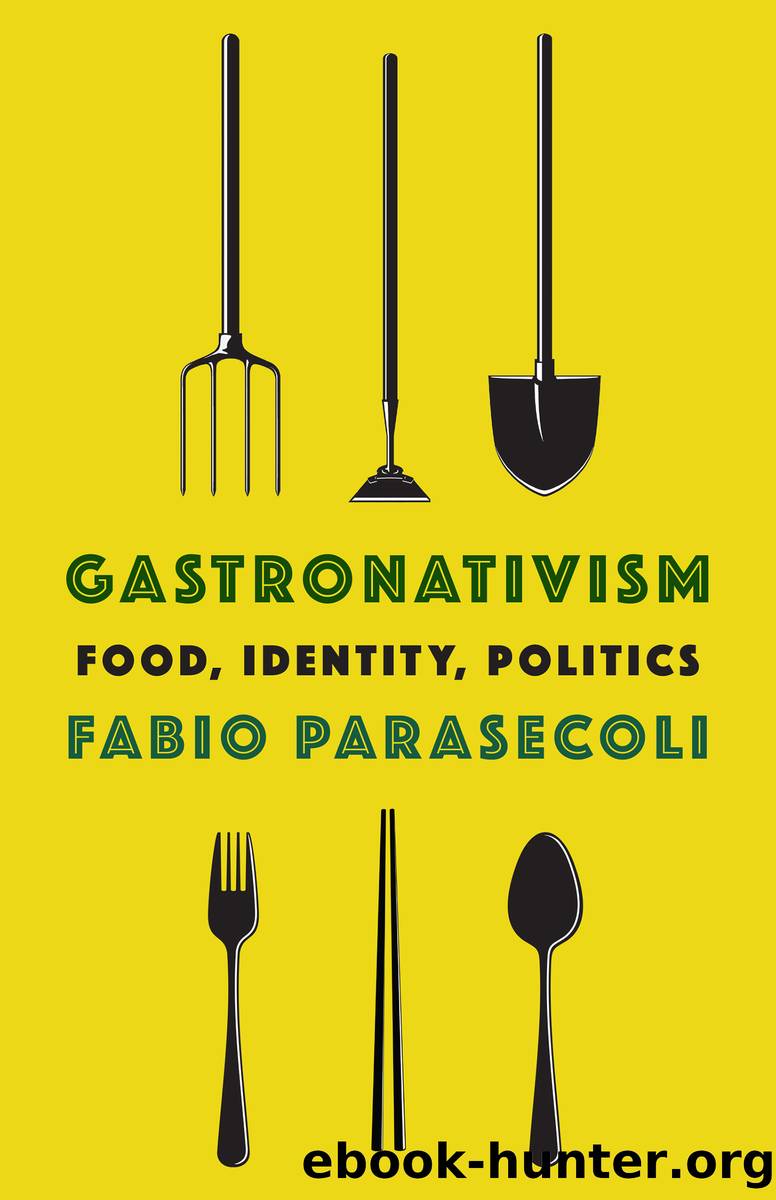
Author:Fabio Parasecoli
Language: eng
Format: epub
Publisher: Columbia University Press
BUILDING NATIONAL CUISINES
The creation of national cuisines is an ongoing process that is easily coopted in national construction or reconstruction. In Catalonia, local actors ranging from citizens to political authorities vie for greater autonomy from the national Spanish government and cherish regional culture to nourish their sense of nation, authenticity, and heritage. However, because of the political tensions with Madrid, any reference to Catalan culinary traditions as a national cuisine is a touchy issue. Against this background, in the early 2000s, local universities and the Catalan Institute of Cuisine and Gastronomic Culture, a private foundation, launched a study of the territory that aimed at taking a snapshot of the culinary landscape as it was at that specific moment. Although led by experts, the project focused on identifying what Catalans themselves consider to be heritage and tradition, not what researchers or authorities may think. Numerous teams traveled throughout all the counties of the region, organizing focus groups and interviewing restaurant goers, housewives, cooks, and local experts. The respondents indicated the dishes they considered as part of their family customs and daily practices. For these dishes to be included in what became the Corpus of Catalan Culinary Heritage, they had to show at least a fifty-year-long history (more or less three generations) and they could not be the invention of a single family or village.17 In order to meet the latter requirement, the dishes had to be found in at least three different locations. Through this process, around nine hundred dishes were identified, each with their local variations in ingredients and techniques. The experiment established a methodology that was meant to be applied at different intervals of time while providing a model for other regions or countries. In 2011, a first revision took place and more dishes were added, reaching a total of about eleven hundred, integrated with analysis of traditional cookbooks. A second revision is in the works. The process presents a mix of top-down and bottom-up approaches, which reflects the desire to recognize the distinctiveness of Catalan cuisine and Catalan culture while also raising its profile internationally, as Catalonia has become one of the main destination for global tourism.
In Colombia, access to foods and products from all over the country, characterized by an astonishing biological, agricultural, and ethnic diversity, is one of the most tangible effects of the process of pacification that is meant to put an end to the conflict among the government and various guerrillas and paramilitary groups. The Colombian government entered in talks with the AUC paramilitary (Autodefensas Unidas de Colombia, or United Self-Defense of Colombia) in 2003 and signed an agreement with the FARC guerrillas (Fuerzas Armadas Revolucionarias de Colombia, or Revolutionary Armed Forces of Colombia) in 2016. While the conflict and the activities of the drug cartels previously hampered communication and physical transportation of goods (including food), now it is possible for Colombians to explore the culinary richness of their country. In this spirit, in 2012, the Ministry of Culture launched the Biblioteca Básica de
Download
This site does not store any files on its server. We only index and link to content provided by other sites. Please contact the content providers to delete copyright contents if any and email us, we'll remove relevant links or contents immediately.
| Anthropology | Archaeology |
| Philosophy | Politics & Government |
| Social Sciences | Sociology |
| Women's Studies |
The Secret History by Donna Tartt(19086)
The Social Justice Warrior Handbook by Lisa De Pasquale(12190)
Thirteen Reasons Why by Jay Asher(8909)
This Is How You Lose Her by Junot Diaz(6885)
Weapons of Math Destruction by Cathy O'Neil(6279)
Zero to One by Peter Thiel(5801)
Beartown by Fredrik Backman(5754)
The Myth of the Strong Leader by Archie Brown(5507)
The Fire Next Time by James Baldwin(5442)
How Democracies Die by Steven Levitsky & Daniel Ziblatt(5218)
Promise Me, Dad by Joe Biden(5153)
Stone's Rules by Roger Stone(5087)
A Higher Loyalty: Truth, Lies, and Leadership by James Comey(4960)
100 Deadly Skills by Clint Emerson(4924)
Rise and Kill First by Ronen Bergman(4788)
Secrecy World by Jake Bernstein(4752)
The David Icke Guide to the Global Conspiracy (and how to end it) by David Icke(4717)
The Farm by Tom Rob Smith(4507)
The Doomsday Machine by Daniel Ellsberg(4490)
